
Call Us
+91-9717252255
Email Us
sales@vinylpipes.com
+91-9717252255
sales@vinylpipes.com
An irrigation system is only as reliable as its pipes. A leaking or rusting line wastes water and pumping energy, and a pipe that is too small or too weak for the pressure fails early. uPVC pressure pipe is a common choice for farm water lines because it does not rust, is light to handle and is easy to lay underground.
Vinyl uPVC pressure pipes are made for municipal water supply, irrigation and industrial lines. They handle high internal pressure, resist corrosion and are safe for drinking water, which suits farms that use the same source for livestock or household use.
| Parameter | Vinyl uPVC pressure pipe |
|---|---|
| Pressure classes | Class I to V |
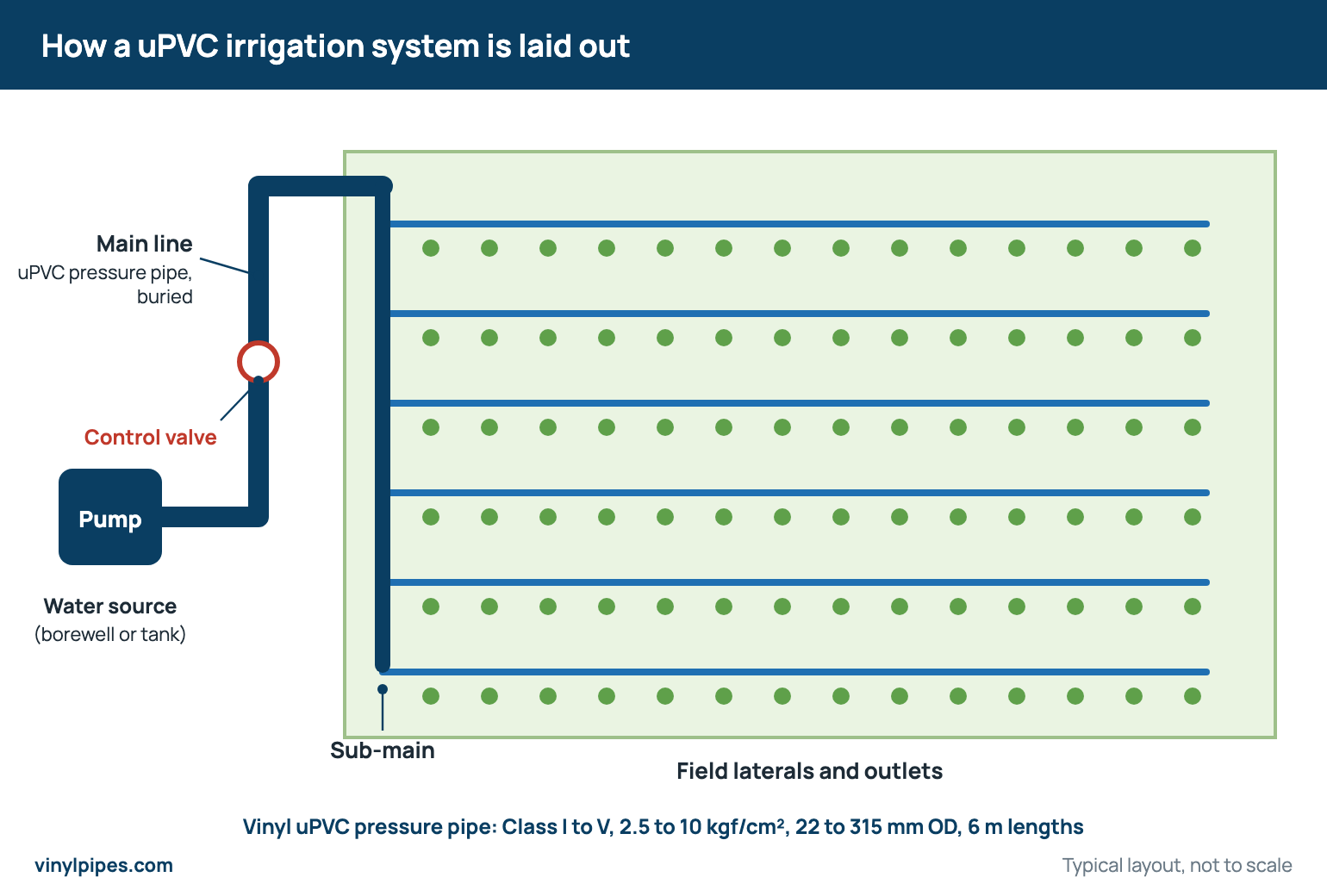
| Working pressure range | 2.5 to 10 kgf/cm² |
| Outside diameter | 22 mm to 315 mm |
| Standard length | 6 m |
| Installation | Underground |
uPVC pressure pipe is rigid and comes in 6 m lengths, which suits straight buried mains. HDPE is flexible and joined by heat fusion, which suits long buried runs over uneven ground. Many farms use both. Our guide to uPVC vs HDPE pipes compares them in detail.
If the water comes from a borewell, the pump sits on a column pipe inside the casing and feeds the surface line. Vinyl makes uPVC column pipes for that job, and the same corrosion-free advantages carry through the whole system.
uPVC pressure pipe is normally used for the main and sub-main lines that carry water across the field. Drip and sprinkler laterals are usually a separate, smaller-bore pipe chosen for the emitters; confirm the combination with your irrigation designer.
uPVC does not rust, and its smooth bore helps water flow, which reduces the build-up that can restrict metal pipes.
Pick the class whose rating is above your maximum working pressure including surges. Higher classes cost more, so avoid over-specifying, but never run a pipe near its limit.
Planning a project? See pipes for agriculture and irrigation or contact Vinyl Pipes with your pump pressure, flow and line length.