
Call Us
+91-9717252255
Email Us
sales@vinylpipes.com
+91-9717252255
sales@vinylpipes.com
uPVC and HDPE are the two most widely used plastic pipe materials for water supply and irrigation. Vinyl Pipes manufactures both, so this guide compares them using the specifications of our own uPVC pressure pipes and HDPE pipes.
uPVC (unplasticized polyvinyl chloride) pressure pipes are rigid pipes built to withstand substantial internal pressure. They are used across industrial, municipal and residential sectors, and in agricultural irrigation, landscaping, geothermal heating and cooling systems, and wastewater management.
HDPE (high-density polyethylene) pipes are flexible pipes made from 100% virgin-grade PE-63, PE-80 and PE-100 material. Vinyl HDPE pipes are manufactured in compliance with BIS standard IS 4984 and are mainly installed below the soil surface.
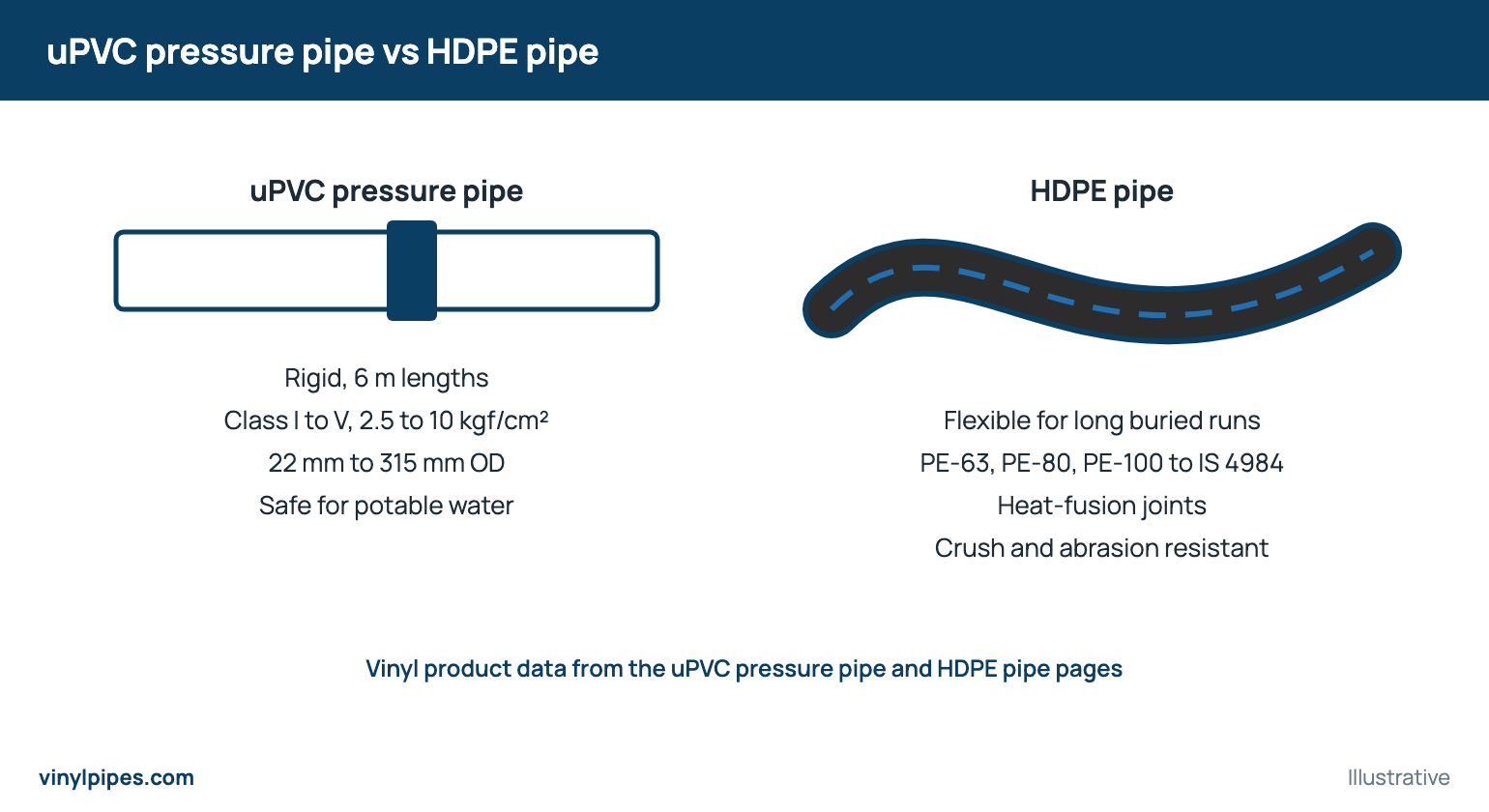
| uPVC Pressure Pipe | HDPE Pipe | |
|---|---|---|
| Material | Unplasticized polyvinyl chloride | High-density polyethylene (PE-63, PE-80, PE-100) |
| Rating / standard | Class I to V, 2.5 to 10 kgf/cm² | IS 4984 |
| Form | Rigid, 6 m lengths | Flexible |
| Jointing | Leak-proof pipe joints | Heat fusion (butt fusion or electrofusion) |
| Typical uses | Municipal and industrial water supply, irrigation mains, wastewater | Buried potable water and irrigation lines, bore-well projects, mining and slurry |
Choose uPVC pressure pipes when you need a rigid pipeline with a defined pressure class for water supply or irrigation mains. The range of classes from 2.5 to 10 kgf/cm² lets you match the pipe to the working pressure, the pipes are safe for drinking water, and they perform reliably in buried or concealed installations.
Choose HDPE pipes when flexibility matters, for example long buried runs that must be handled and laid over distance, or ground where crush resistance is important. Heat-fused joints create a continuous, leak-proof line, and HDPE is also suited to demanding uses such as mining and slurry transport.
Yes. Vinyl uPVC pressure pipes are made from non-toxic materials and are free from harmful contaminants, so they are safe for delivering clean, potable water.
HDPE pipes are joined by heat fusion methods such as butt fusion or electrofusion, which melt the pipe ends together to form a seamless joint that is stronger than the pipe itself.
Yes. uPVC pressure pipes are used for agricultural irrigation and landscaping, and HDPE pipes are installed below the soil surface for irrigation networks and bore-well projects.
For borewell-fed irrigation, see our uPVC casing pipes and uPVC column pipes, or explore pipes for the agriculture and irrigation industry. To get prices, contact Vinyl Pipes.