Borewell recharging means returning rainwater to the ground so that the aquifer feeding a borewell is refilled. Where borewells draw water faster than rainfall replaces it, the water table falls and yields drop. Recharging is one of the simplest ways to slow that decline.
This guide explains the two main methods, the steps for a rooftop system, and why the casing and screen pipe in the borewell matter.
Two ways to recharge a borewell
Direct recharge: filtered rainwater is led straight into the borewell casing and leaves through the slotted screen section into the aquifer. It is mainly used for borewells that have run dry or give very little water. Because the water goes directly into the aquifer, it must be clean and filtered first.
Indirect recharge: water is spread into recharge pits, trenches or shafts near the borewell. It seeps down through soil and sand, which act as a natural filter, and reaches the aquifer that supplies the well. It is slower but the ground does part of the cleaning.
How a rooftop recharge system works
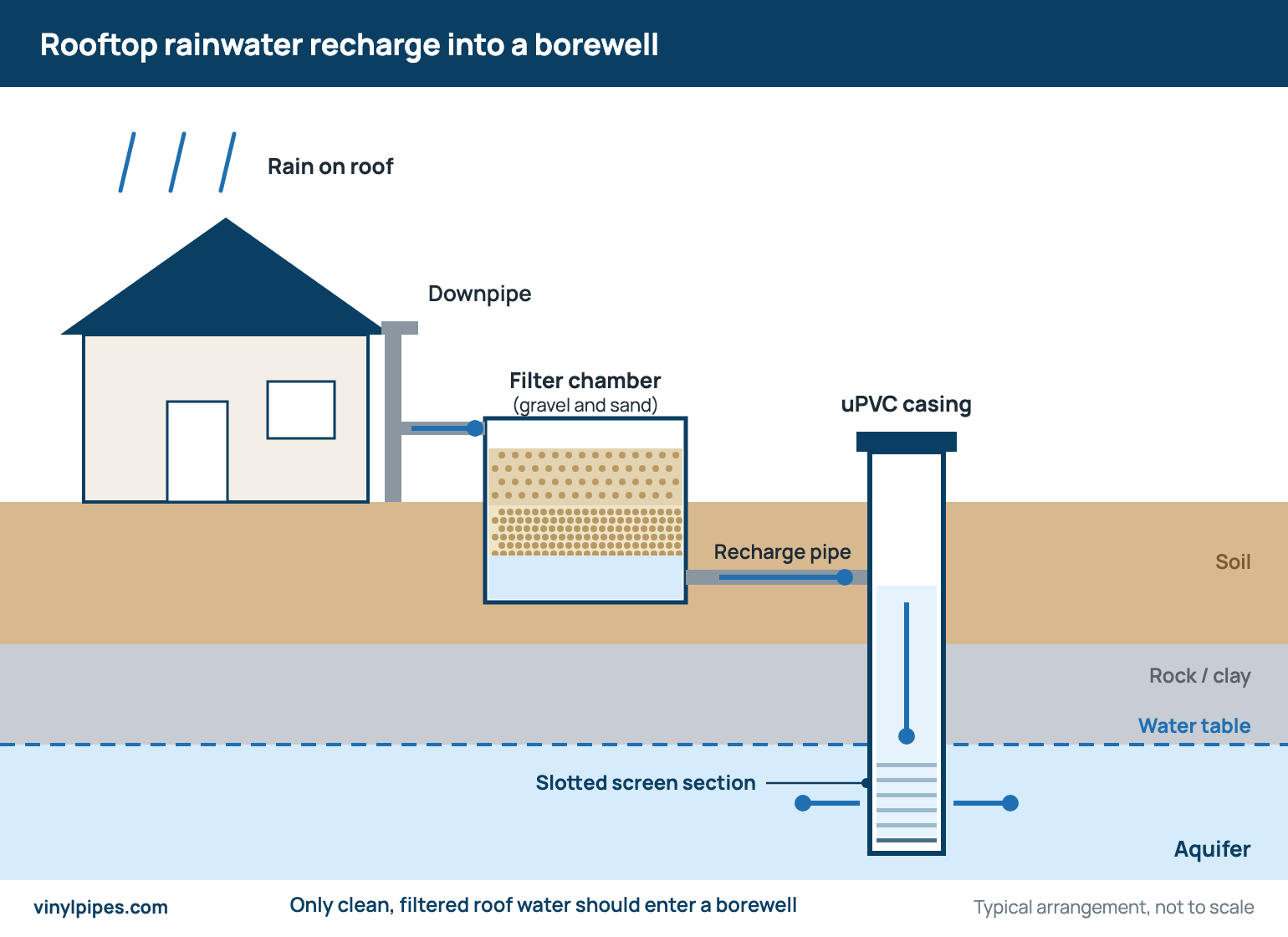
Typical rooftop recharge: roof, downpipe, filter chamber, recharge pipe and a borewell with a slotted screen section.
Collect roof water. Rain from a clean roof is carried by the downpipe.
Let the first rain go. The first showers wash dust and debris off the roof. Divert this water away before switching the system on.
Filter it. Pass the water through a filter chamber filled with layers of gravel and sand to hold back silt and leaves.
Feed the borewell. A recharge pipe carries the filtered water into the borewell casing.
Let it drain into the aquifer. The water leaves the casing through the slotted screen section and enters the aquifer.
Maintain the filter. Clean the chamber before every monsoon and after heavy silt loads.
Why the casing and screen pipe matter
Recharge water has to get out of the casing and into the aquifer, so the screen section must stay open for years. Casing that rusts or scales can block the slots. Vinyl uPVC casing pipes are corrosion resistant and withstand pH levels from 2 to 12, and Vinyl also supplies screen pipes with precision-engineered slots that filter sediments. Slots cut at the factory are more reliable than holes drilled in the field, which tend to be rough and clog more easily. See how well screens work for slot and gravel pack basics.
Precautions
Use only clean roof rainwater. Never let sewage, drain water or chemicals reach a borewell.
Filter every time. Silt and organic matter carried into the aquifer can reduce yield and spoil water quality.
Follow local rules. Groundwater regulations vary by state and country.
Get a design. A driller or hydrogeologist can size the filter and check whether your ground conditions suit direct or indirect recharge.
Treat drinking water as usual. Recharging refills the aquifer; it does not make borewell water safe to drink without treatment.
Frequently asked questions
When should a borewell be recharged?
Get the system ready before the monsoon, so the filter is clean and the first rain can be diverted before collection starts.
Can any borewell be recharged?
Most borewells with an intact casing can take recharge water, but the right design depends on the local geology and the state of the well. Ask a driller to inspect it first.
Does recharging clean the water?
Filters and soil layers remove solids, but they do not make water fit to drink. Treat borewell water for drinking in the usual way.