
Call Us
+91-9717252255
Email Us
sales@vinylpipes.com
+91-9717252255
sales@vinylpipes.com
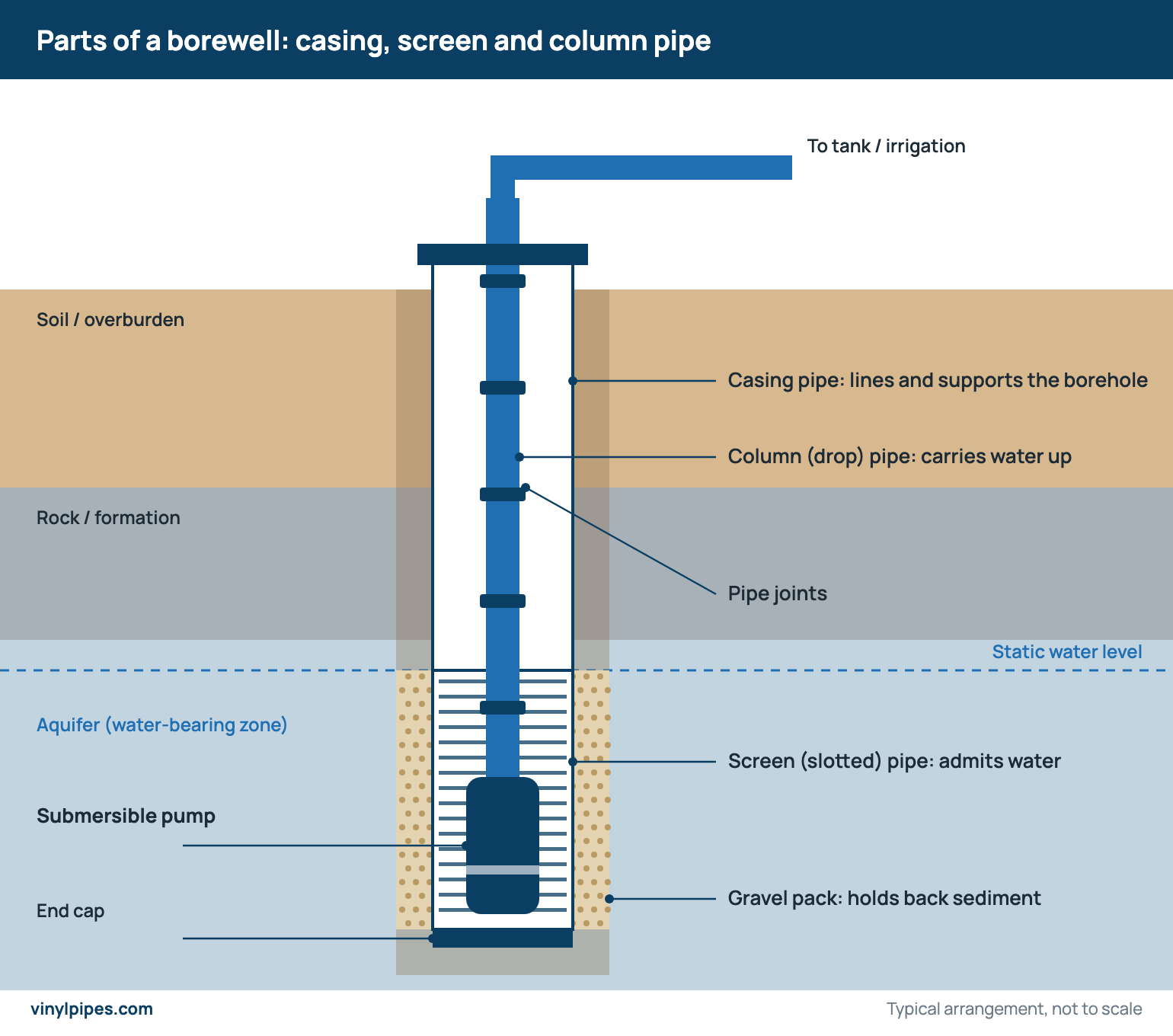
Casing is the lining of a borewell. It holds the borehole open, keeps soil and loose rock out, and protects the water that enters the well. Choosing the right borewell casing pipe depends mainly on depth, ground conditions and the pump that will be installed inside it.
A casing pipe supports the structure of the well. Plain casing runs through the upper, unstable layers, and screen (slotted) casing is placed where groundwater enters. The pump and column pipe are then lowered inside the casing.
Vinyl uPVC casing pipes come in two variants, each suited to different borewell depths and geological conditions.
| Parameter | Vinyl uPVC casing pipe |
|---|---|
| Material | Unplasticized polyvinyl chloride (uPVC) |
| Yield stress | 55 N/mm², prevents deformation |
| pH resistance | Suitable for pH 2 to 12 |
| Density | Higher than water, for structural advantage |
| Depth | Deep Well variant up to 600 m |
Yield stress is the stress a material can take before it deforms permanently. A yield stress of 55 N/mm² shows high stiffness, so the casing resists external ground pressure and keeps the well intact over the long term.
uPVC offers exceptional corrosion and bacteria resistance, is lightweight for easy installation, and is non-toxic, which makes it more cost-effective and safer for clean water over time. Steel casing can corrode in groundwater and is much heavier to transport and lower into the borehole. In the United States this product is usually called PVC well casing; the role in the well is the same.
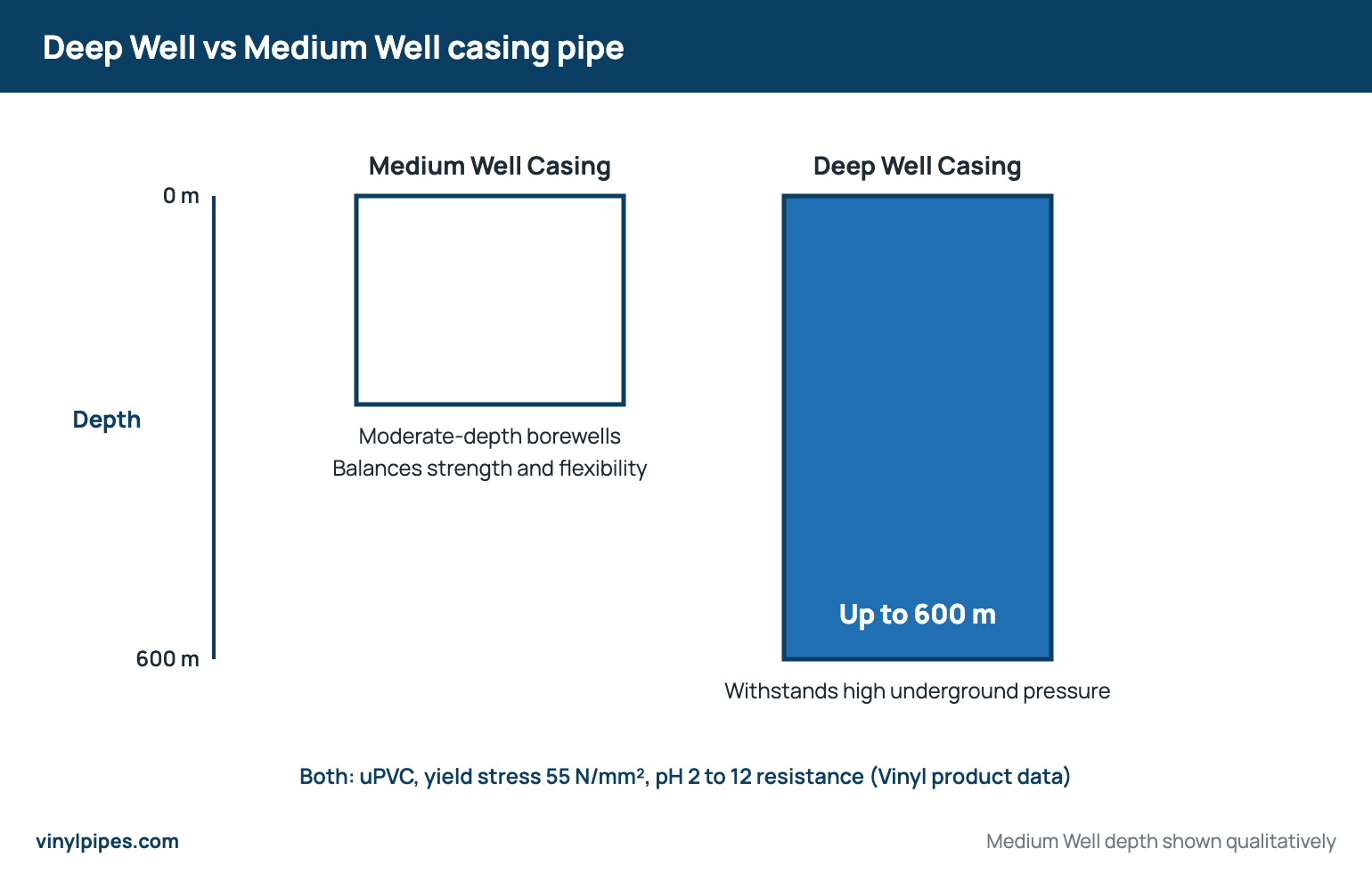
Deep Well pipes are high-strength, designed for borewells up to 600 m to withstand deep underground pressures; Medium Well pipes balance strength and flexibility for moderate depths.
Because of their durability and corrosion resistance, uPVC casing pipes have a very long lifespan and need minimal upkeep, which makes them a low-maintenance, cost-effective solution.
Vinyl also manufactures dewatering casing pipes designed for groundwater control in construction and excavation projects.
Ready to order? Contact Vinyl Pipes for borewell casing pipe prices, or explore pipes for the water well industry.