
Call Us
+91-9717252255
Email Us
sales@vinylpipes.com
+91-9717252255
sales@vinylpipes.com
Every submersible pump hangs on a pipe that carries water to the surface. In India it is usually called a column pipe; in the United States a drop pipe; elsewhere a riser pipe. The pipe you choose affects water quality, how easily the pump can be installed or pulled, and how long the system lasts.
The three common choices are uPVC column pipe, galvanised iron (GI) pipe and steel pipe. Here is how they compare.
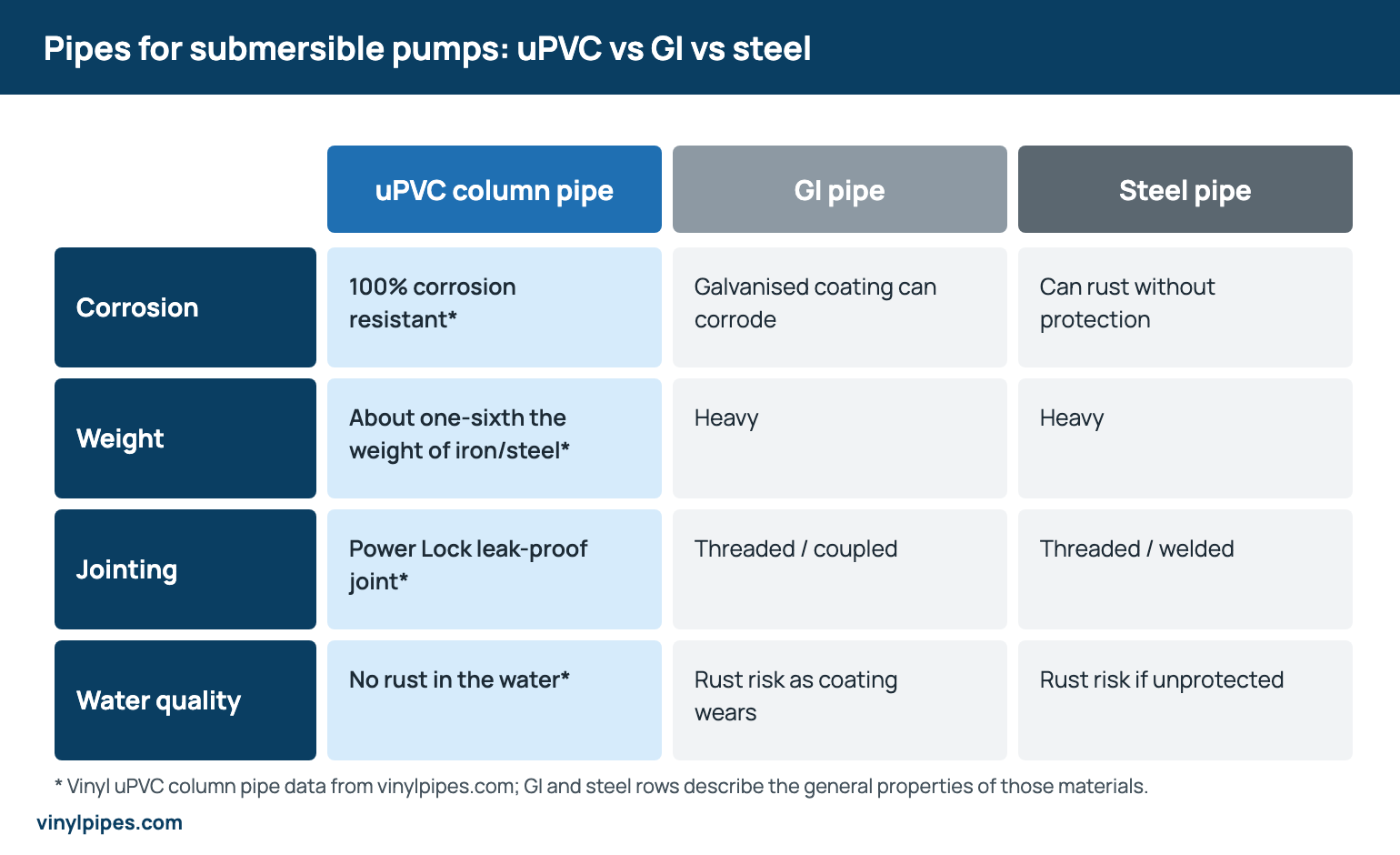
uPVC column pipes are now widely used for borewell pumps because they do not rust. Vinyl uPVC column pipes are made from a compound of 92% PVC polymer, 3% reinforcing agents and 3% titanium using biaxially oriented extrusion. According to Vinyl's product data they are:
GI pipe is steel pipe with a zinc coating. It has been used for decades and is strong, but it is heavy, so installation and pump removal usually need more labour or lifting equipment. The zinc coating protects the steel only while it lasts; in many groundwater conditions it wears over time, after which the pipe can corrode, scale and discolour the water. For a deeper look, read our uPVC riser column vs GI pipes comparison.
Plain steel pipe is strong but will rust unless it is protected. Stainless steel resists corrosion much better, but it is heavy to handle and a significant cost for long pipe strings.
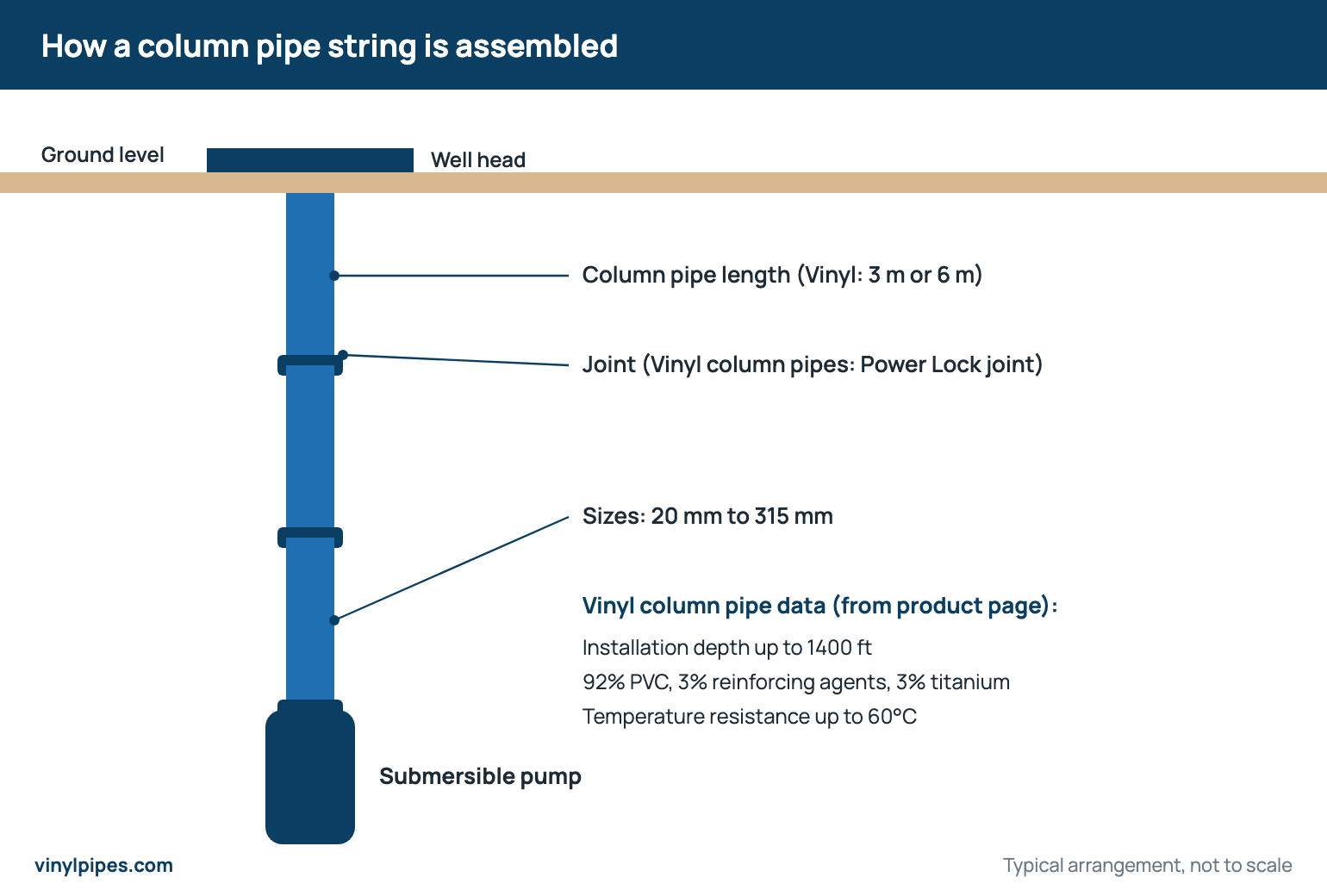
Column pipes are supplied in fixed lengths and joined one by one as the pump is lowered into the well. Each joint must carry the weight of the pump and the water column below it, which is why joint design matters as much as the pipe itself.
For most borewells, uPVC column pipe is the practical choice: it does not rust, is far lighter than GI or steel, and keeps water clean. Metal pipes remain an option in special cases, but they need protection against corrosion.
Vinyl uPVC column pipes have high tensile strength, are designed to withstand high pressure and are suitable for installation depths of up to 1400 ft.
No. Vinyl uPVC column pipes are 100% corrosion resistant and made with a safe PVC polymer compound, so they deliver clean, potable water.
Need column pipes for a project? See uPVC column pipe specifications or contact Vinyl Pipes for prices.