
Call Us
+91-9717252255
Email Us
sales@vinylpipes.com
+91-9717252255
sales@vinylpipes.com
A piezometer is an installation used to measure groundwater level or pressure at a chosen depth. The piezometric pipe is the pipe that forms it: a plain riser pipe from the surface and a screened section at the depth being monitored. The same construction is used for groundwater monitoring wells in environmental, hydrogeological and geotechnical projects.
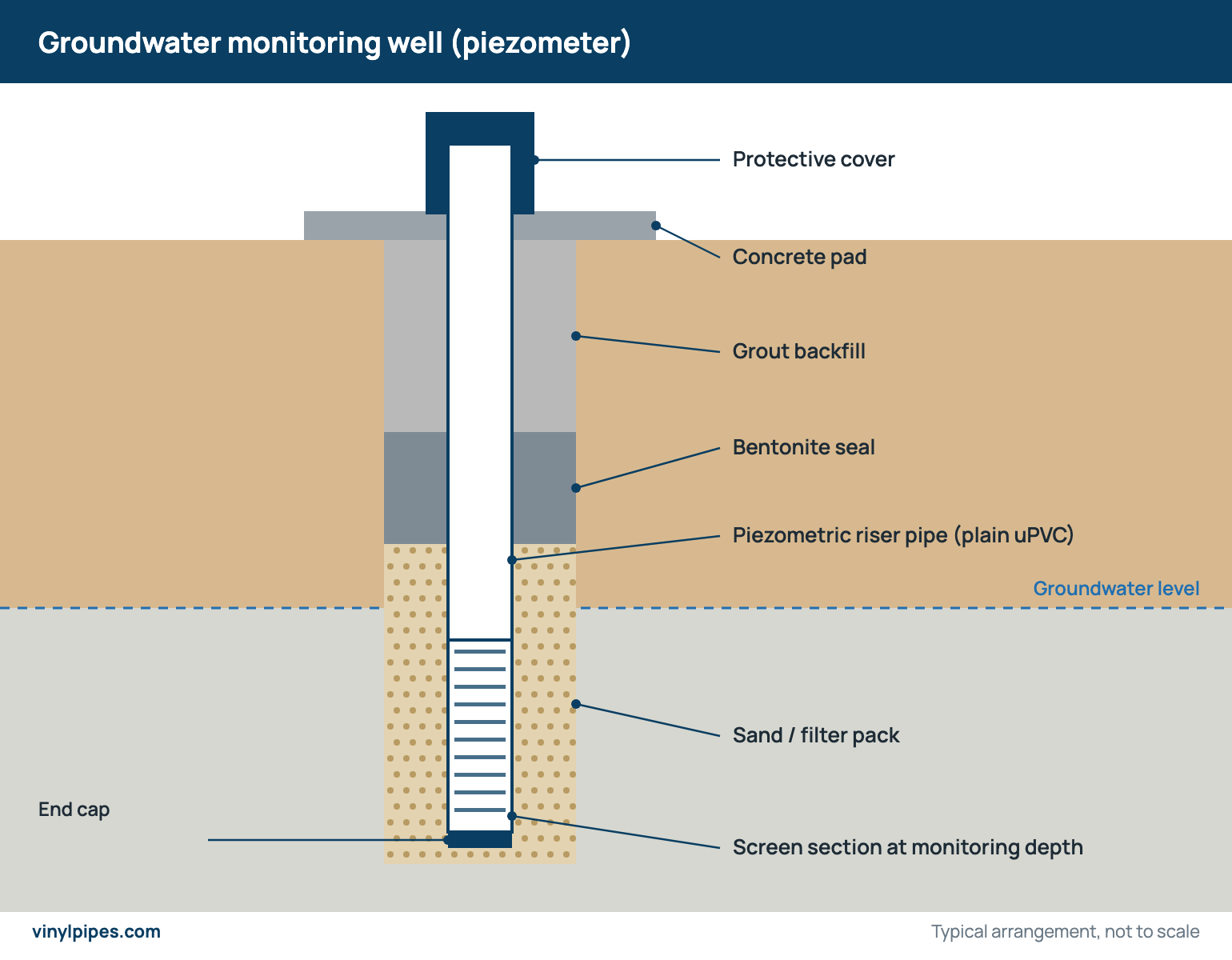
Professionals in geology, hydrology and environmental engineering use Vinyl Piezometric Pipes for:
Monitoring data is only useful if the pipe does not change the water it is measuring. Vinyl piezometric pipes are made from premium-quality uPVC with chemical inertness, so no reaction occurs with groundwater or geological formations, and there is no leaching or contamination during long-term monitoring. They also offer:
| Size | Class | Standard length |
|---|---|---|
| 25 mm | Schedule 40 | 3 m |
| 50 mm | PN18 | 3 m |
| 100 mm | PN12 | 3 m |
The terms overlap. A piezometer is typically installed to measure groundwater level or pressure at a specific depth, while a monitoring well may also be used to take water samples. Both use a riser pipe with a screened section.
Yes. Vinyl piezometric pipes offer a service life exceeding 100 years, for consistent performance in long-term groundwater studies.
The trapezoidal-threaded coupling system gives secure connections without specialised tools, saving time in the field.
See more pipes for monitoring wells or contact Vinyl Pipes for project quantities.