Call Us

+91-9717252255

Email Us

sales@vinylpipes.com

Do Drainage Pipes Need a Slope? How to Lay SWR Pipes Correctly

Yes. A drainage pipe works by gravity, so it must slope continuously toward the outlet. Nothing pumps the wastewater along, which means the pipe's fall is what keeps liquid and solids moving. Get the slope wrong and the line blocks, smells or holds standing water.
Why the slope matters

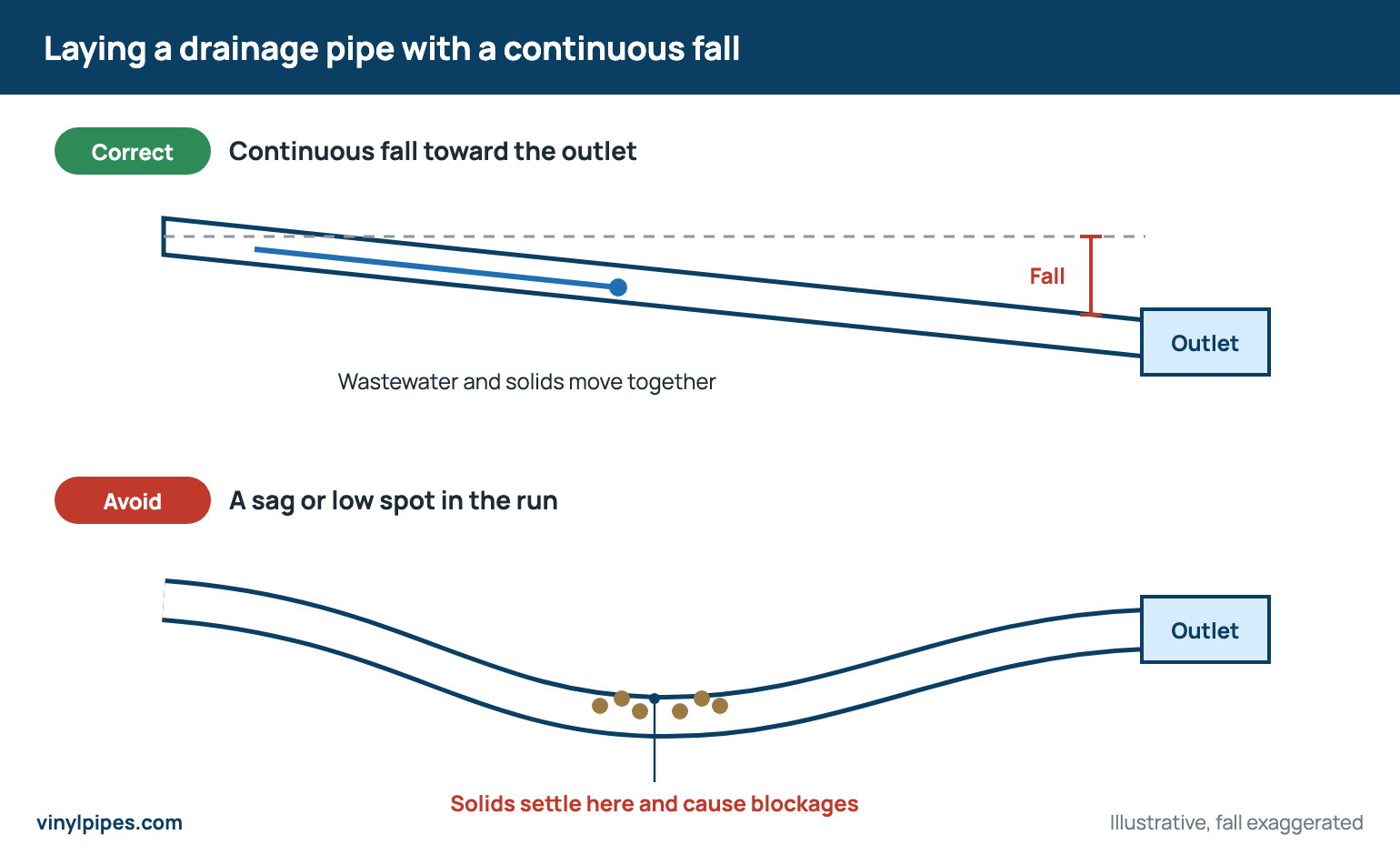
  • Too flat, or with dips: water slows and solids settle. Debris collects at low points until the pipe blocks.
  • A continuous, even fall: liquid and solids travel together and the pipe keeps itself clear.
  • Too steep: water can rush ahead and leave solids behind, so aim for a gentle, even fall rather than the steepest one possible.
Diagram comparing a drainage pipe laid with a continuous fall to one with a sag where solids settle
A continuous fall keeps solids moving; a sag creates a low spot where they settle.

How much slope is enough?

The correct gradient depends on the pipe diameter, the type of drain and your local building rules, so always follow the drainage code or your consultant's drawings. As a commonly quoted starting point for small-bore building drains, the fall is roughly 1 to 2 per cent (1 to 2 cm for every metre of pipe), but confirm the figure for your project. What matters most is that the fall is continuous: one even slope from the highest point to the outlet, with no dips.

Building drainage and land drainage

The same principle applies to both kinds of drainage.

  • Building drainage carries rainwater from the roof and wastewater from bathrooms and kitchens to the main drain or sewer.
  • Surface drainage removes excess water from the surface of land.
  • Subsurface drainage removes water from the root zone of crops, which also helps wash salts out of the soil.

Vinyl SWR pipes for drainage

Vinyl uPVC SWR pipes are made to IS 13592 for soil, waste and rainwater drainage in 75 mm to 160 mm sizes. They have a smooth bore for high flow, are UV resistant and suit both underground and surface use. Each pipe has one plain end and one self-socketed end with an integral groove that holds a rubber gasket, so the joint accommodates thermal expansion and contraction.

Laying checklist

  1. Plan the levels from the outlet. Work upstream from the discharge point so the fall is built into every length.
  2. Prepare an even trench bed. Remove sharp stones and compact the base so the pipe does not settle later.
  3. Place the socket end facing upstream. The plain end of each pipe then enters the next socket in the direction of flow.
  4. Check the fall as you go. Use a spirit level or levelling instrument on every length, not only at the end.
  5. Support surface runs. Fix pipes at regular intervals so they do not sag between brackets.
  6. Backfill in layers. Compact around and above the pipe evenly to avoid dips.
  7. Test before covering. Run water through the line and watch for leaks, pooling and slow flow.

Common mistakes

  • Sags or "bellies" caused by an uneven trench bed or poor backfill
  • Backfall, where a length slopes the wrong way
  • Unsupported sections on surface runs
  • Sharp 90 degree turns where two gentler bends would flow better
  • No inspection access at changes of direction

Frequently asked questions

Can a drainage pipe have too much slope?

Very steep runs can let water outrun solids. Follow the gradient in your drawings or code rather than laying the pipe as steeply as possible.

What if the site is very flat?

On flat ground the run may need to start deeper, use larger or fewer bends, or include inspection chambers or a lift. Ask your plumbing or civil consultant to review the levels.

Are SWR pipes only for buildings?

Vinyl SWR pipes can be used underground and on the surface for soil, waste and rainwater drainage. See pipes for the construction industry for the full range.

Need drainage pipe quantities for a project? Contact Vinyl Pipes.

Sorry, your browser does not support inline SVG.